PODCAST-VERA, OR FAITH-BOOK REVIEW
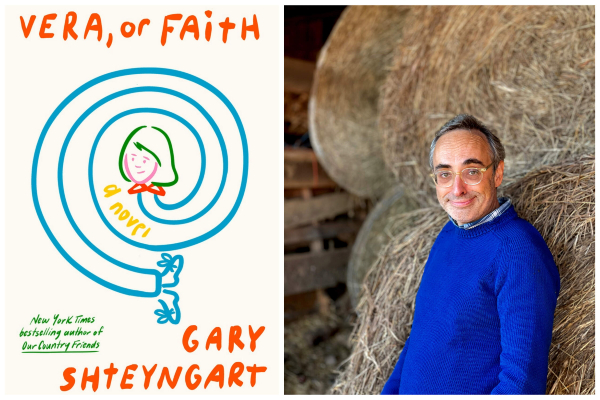
PODCAST: VERA, OR FAITH—BOOK REVIEW
Gary Shteyngart’s book, Vera, or Faith, is a masterpiece. Last Friday night, I chose finishing the book rather than going to a dance with friends. If you know me at all, this is high praise.
The slender 241-page novel is about a precocious ten-year-old named Vera, the daughter of Igor, a man who came from Russia as a child, and a Korean woman, who seems to have abandoned Vera and might be dying of cancer. Vera’s stepmother, Anne Bradford, is the primary person raising Vera and Dylan, Vera’s younger stepbrother. Dylan, a blond, curly-haired bundle of energy is the golden child, a boy whose antics steal the show at gatherings of family and friends.
Vera spends her young life trying to impress her father, a once famous man who has transitioned from fame to infamy in the public eye. He’d hoped to make great gobs of money by selling his magazine to a Rhodesian businessman who, like the rest of polite society, is currently ghosting Igor. Vera’s father now spends much of his time in his underwear, on the couch, often talking to himself.
Set in the dystopian near future, this novel is filled with hilarious and trenchant social and political commentary. Topics include but are not limited to the pressure parents put on ten-year-olds to get into the “right” college—Igor’s vision for Vera is Swarthmore. The contrast between Anne’s blue-blooded New England mother and Igor’s Russian Jewish immigrant parents who have developed a curious way of adapting to American life—a way reminiscent of my own Italian immigrant grandparents. And, a topic that provides a narrative scaffolding for the book, the attempt of the rightwing autocratic state to push through an amendment that would dilute voting power for anyone not directly related to pre-revolutionary war white settlers. Remind you of anything?
The beating heart of the novel is Vera, a brilliant, but socially wobbly child with a complicated Jewish Russian/Korean heritage. Vera’s living space is a metaphor for how she feels about her place in the family. It is structured such that her parents and Dylan have bedrooms in one wing which is separated from Vera’s bedroom by a kitchen and living room. Vera refers to the couch as the Maginot Line. She feels like a castoff, abandoned, marooned, and desperately lonely.
Some positives exist in Vera’s grim life. One is Kaspie, an AI chess game, made in Korea. This robot answers random questions, and at times, seems to be sentient. For example, Kaspie is happy to find out that Vera shares its connection to Korea.
Another bright spot is Vera’s budding friendship with Yumi, a fellow student at the liberal magnet school Vera attends. But Vera’s true emotional lifeline is her Aunt Cecile, who loves Vera unconditionally and affirms her at every opportunity. Vera refers to her aunt as her nightlight, her human weighted blanket. Both Cecile and Anne help Vera navigate school and basic daily life.
Shteyngart tells his story via Vera’s close point of view. The voice he creates for her is entrancing, so engaging that I didn’t need much additional tension in the narrative to keep me reading. Vera’s observations are fresh, funny, and insightful. I love the way Shteyngart has Vera quote Cecile and Anne’s advice as she manages her days, which, in its own way, provides a sharp critique of the social mores the child is trying to decipher.
At first, I didn’t quite buy the way the novel wraps up. But I reminded myself that this story is set in the future, so perhaps this plot point would be a possibility. Regardless, I found the ending satisfying, even comforting in its own way.
Vera is a fun, funny book—an intelligently written escape from reality. I read a borrowed copy. I plan to buy my own. This novel is a keeper.
###

Podcast: Play in new window | Download
I’m glad you liked that book, Debby. I enjoyed it even though I was at first afraid that it might be a bit too dystopian for me. The world worked enough and wasn’t so dark that I wanted to crawl under the covers and never come out. I liked how Vera’s search for value through changed circumstances got kind of turned on its head at the end.
I agree. I think the grim, dystopian aspect of the book was balanced by the tender portrayal of Vera’s character. I liked the way the author used the school debate to weave in the political themes.
I started this book several months ago and set it aside. Will be picking it up again! Thanks for this review, Debby.
I’m really interested in reading Vera after this insightful review. Thanks!